OpenStack

The basis of af.stack is the powerful OpenStack platform, which has been tried and tested thousands of times. OpenStack has been developed as open-source software since 2010 and has grown from a simple virtual server platform into a powerful cloud environment.

With af.stack, we provide you with the full range of OpenStack infrastructure options in addition to the simple virtual server interface of the DCP.

af.stack API access

If you have activated API access in the DCP, you can access OpenStack directly via the OpenStack web interface Horizon, for example. This gives you options that go far beyond what is possible in the DCP, including:

  • Connecting your own networks with virtual routers
  • Creating multiple network interfaces for your server instance
  • Creating your own network security rules
  • Uploading and creating your own installation images
  • Creating complex setups with Heat templates
and much more.

The API to the API

In addition to the Horizon interface, OpenStack also provides a powerful REST API that you can use with your own applications or with the many available OpenStack command-line clients. The API offers significantly more options for managing your af.stack installation.

At the same time, the API opens up almost endless possibilities for integrating af.stack into automation and cloud management tools such as Ansible, Puppet, or Terraform.

Under the hood

The main work in the OpenStack Cloud is carried out by three services: Nova controls the hypervisors (KVM), Cinder creates and manages the storage volumes, and Neutron takes care of the network connections.

In af.stack, Cinder storage is always provided by a Ceph cluster, which offers both extremely fast but relatively cost-intensive NVMe SSDs and inexpensive traditional HDDs.

We do not use local volumes in order to enable live migration of servers and thus allow hypervisor updates without interrupting server availability.

Network Inception

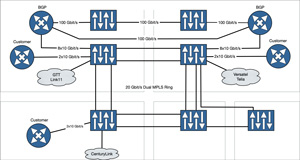
In order to distribute all services across the entire cloud with the highest possible availability and without manual intervention, network virtualization in af.stack starts at the lowest level: all systems communicate via an IP fabric using VXLAN and EVPN. This shifts redundancy and scalability from the more error-prone Layer 2 to Layer 3, increasing both the stability and security of the network.

Someone Else’s Computers

Ultimately, of course, the virtual cloud must also run on real hardware. Here, we rely on the latest Intel Gold CPUs with at least 3.2 GHz and up to 384 GB of RAM. We use both Supermicro and Dell as our server platforms.

All servers have extensive management and monitoring functions and are redundant in terms of both network and power supply.

Of course, we always keep sufficient hardware capacity in reserve to compensate for failures and increasing demand.

Any questions?

If you have any questions about af.stack or would like to implement special projects, please contact our technical colleagues. Here you can contact our developers and technicians directly.

Live Chat

x